






AI
Auto-Scoring Across Thirty Rule Sets: The Hardest Problem in Sports AI
Detecting that a point was scored is the easy part. Knowing whose point it is, under which rule, and what the score now reads is the hard part.
There is a comfortable assumption in sports technology that automatic scoring is a computer vision problem: see the ball land out, award the point, done.
Vision is the easy half. The hard half is that seeing what happened tells you almost nothing about what the score now is.
An example that looks trivial and is not
A shuttle lands outside the sideline. Vision reports it with high confidence. Now award the point.
To whom? It depends on who hit it last — which requires the rally's shot sequence, not just this frame. Was it a doubles rally? Then the serve rotation may change, and which player serves next depends on the score's parity and which side just won. Was it match point? Then the match has ended, the bracket must advance, the court is now free, and the scheduler should re-sequence. Was it in the deciding game at 20-20? Then the two-point-margin rule is active and 21 does not end anything.
Vision produced one fact. Turning it into a score required the rally history, the sport's rule set, the match's format and the tournament's structure. That is where the difficulty lives, and it is why we treat auto-scoring as a rules problem with a vision input rather than a vision problem.
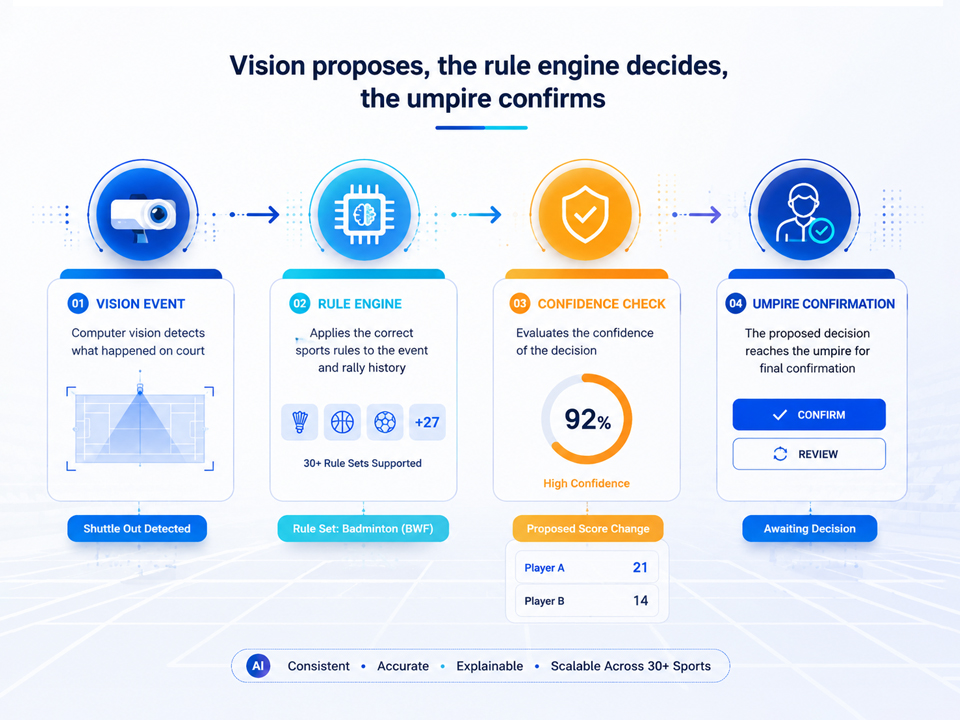
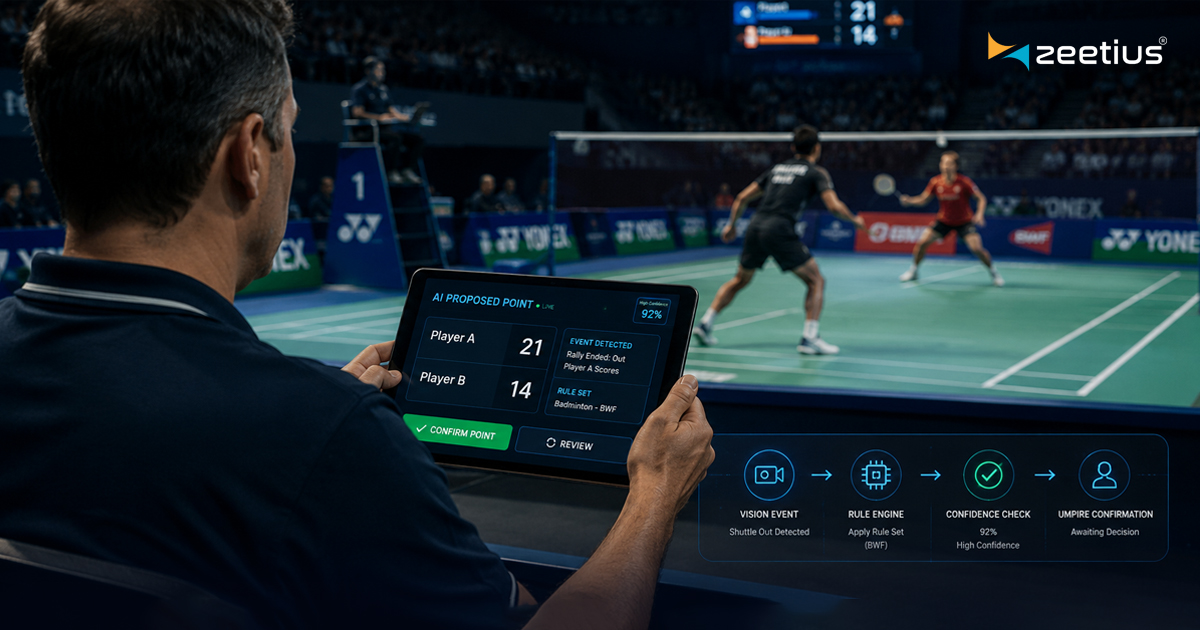
Vision proposes, the rule engine decides, the umpire confirms
The same rule engine described in our multi-sport architecture piece does this work. Vision emits an observation. The engine applies the sport's rules to the rally history and produces a proposed score change. Only then does it reach the umpire — as a pre-filled action to confirm, not as a raw detection to interpret. That ordering is what makes the feature usable rather than a source of extra work.
Confidence has to be a first-class output
A scoring system that is right 97% of the time and cannot tell you which 3% is worse than no system at all, because a human now has to verify all of it.
So every proposal carries a confidence score, and the interface changes behaviour based on it. High confidence auto-advances after a short delay the umpire can interrupt. Medium confidence waits for explicit confirmation. Low confidence — occlusion, ambiguous contact, a line call that was genuinely close — does not propose anything and hands it straight to the official.
Tuning that threshold is a judgement about which error is worse, and the answer differs by context. In a school league, a wrong point auto-confirmed is a minor annoyance. In a national ranking event it is unacceptable, and the threshold moves accordingly.
Why the umpire is never removed
We get asked regularly when auto-scoring will replace officials. The honest answer is that it should not, and not primarily for technical reasons.
An official is not only a score-recorder. They manage conduct, apply judgement to situations no rule anticipates, handle disputes, and carry the accountability that makes a result legitimate. Remove them and you have not automated a job — you have removed the entity that a player can appeal to, and with it the reason anyone accepts the result.
What auto-scoring genuinely removes is the mechanical load: tracking the score, remembering the serve rotation, applying the two-point rule at 20-all, doing arithmetic at hour six. Officials who have used it describe the change as being able to watch the match rather than the scoresheet — which makes them better at the parts only they can do.
Where it is strongest
Best in the racquet sports, where the rule sets are well-bounded and the training data is deepest. Solid in wrestling and the timed team sports for the mechanical parts — clock, period, score arithmetic — with human judgement still doing most of the work on subjective calls. Thinnest in the sports we added most recently, for the obvious reason.
It runs alongside conventional scoring rather than replacing it, and any tournament can turn it off entirely. Nothing about the platform depends on it being on.