






Product launch
Introducing ZetAI: The Sports Intelligence Engine Inside Zeetius
Six purpose-built AI engines — vision, prediction, coaching, scoring, broadcast and fan — trained on billions of plays across 30+ sports.
For five years Zeetius has been doing something unglamorous: recording, precisely and consistently, what happens in sport. Every point in every match, with its context — who served, what the score was, how long the rally lasted, which round of which event on which court.
Roughly 150,000 matches later, that record has become the most valuable thing the company owns. Today we are shipping what it was for.
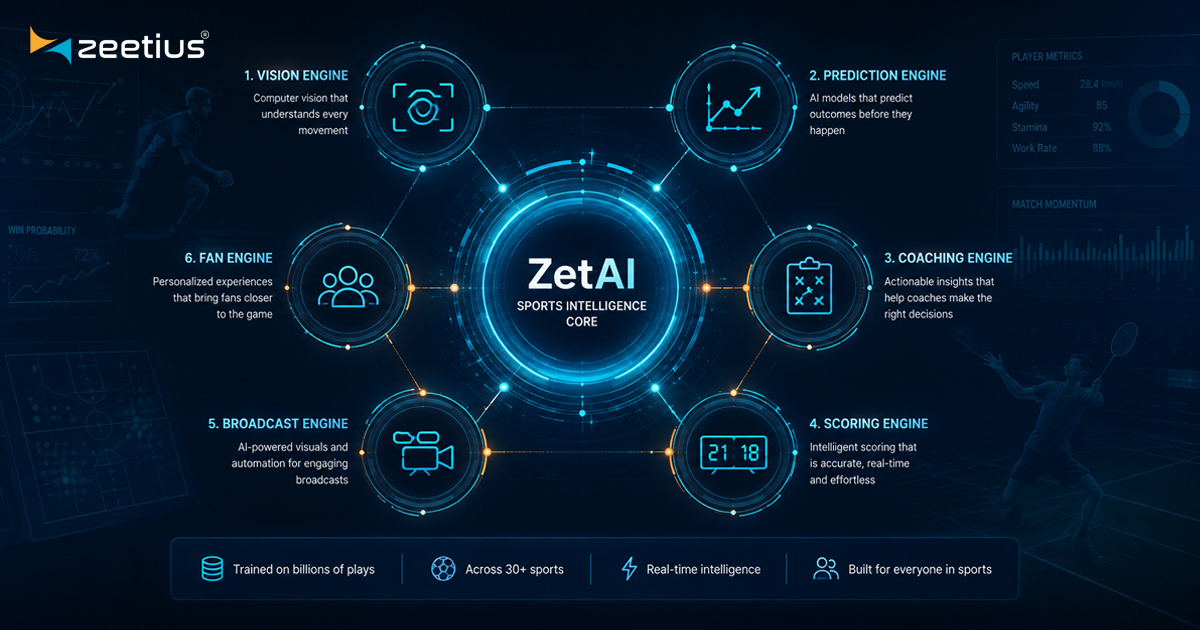
ZetAI is the artificial intelligence engine inside the Zeetius ecosystem: a stack of computer vision, predictive analytics, deep learning and generative models trained on billions of plays across more than thirty sports.
Six engines, one brain
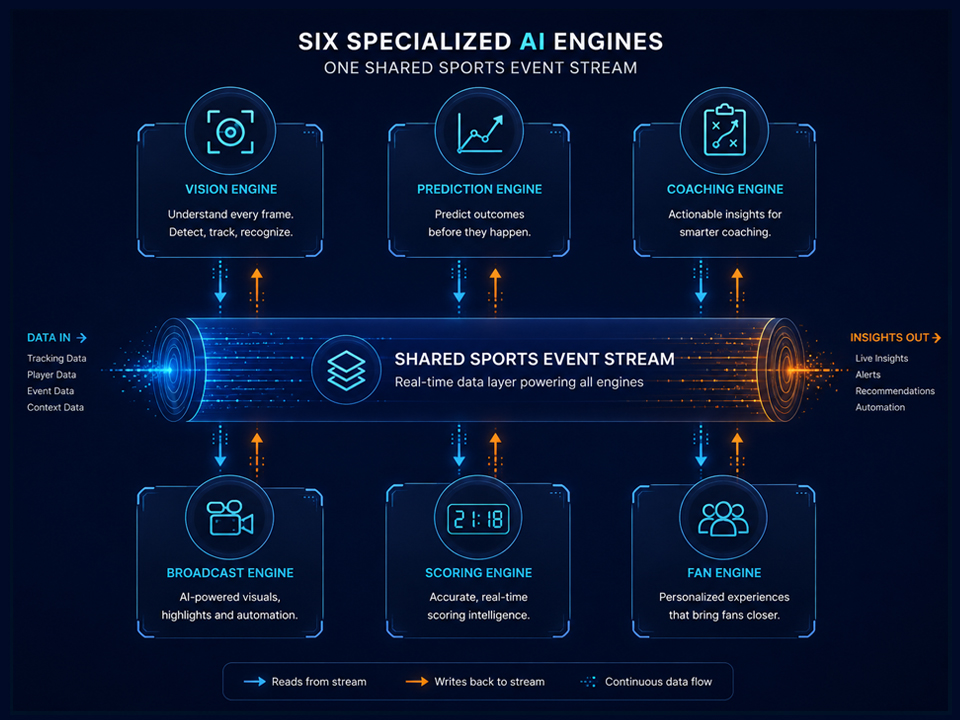
ZetAI is not one model. It is six purpose-built neural networks, orchestrated together and continuously learning from the same event stream.
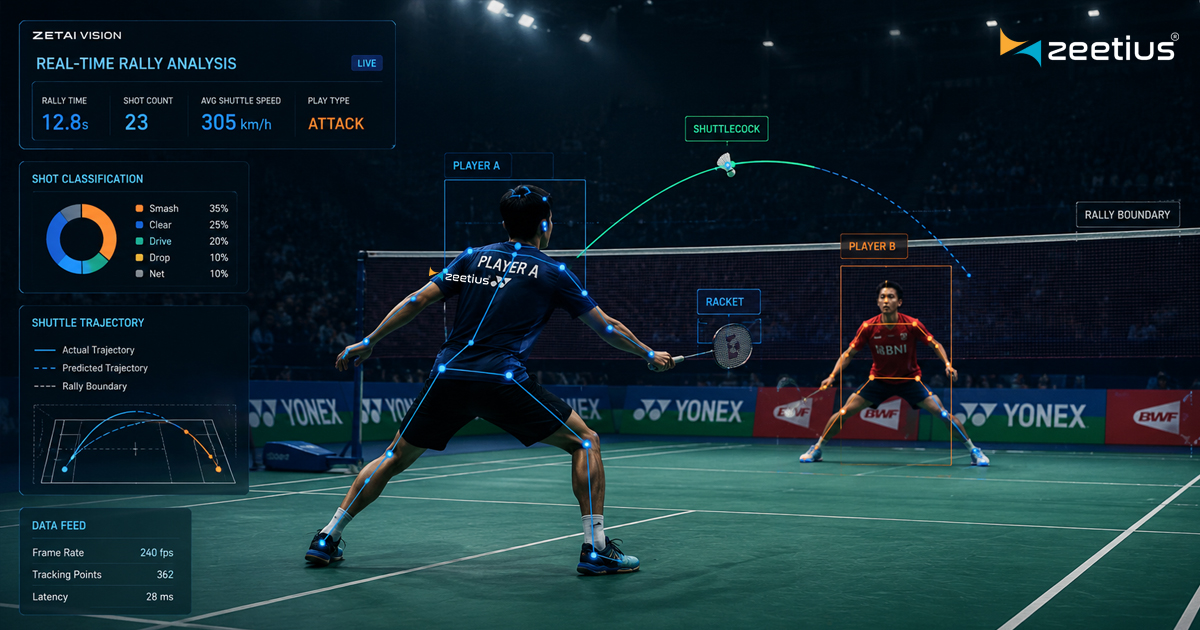
- ZetAI Vision — multi-camera tracking of players, ball, racket and arena events at 240 frames per second. Auto-detects rallies, shot types, fouls and key moments.
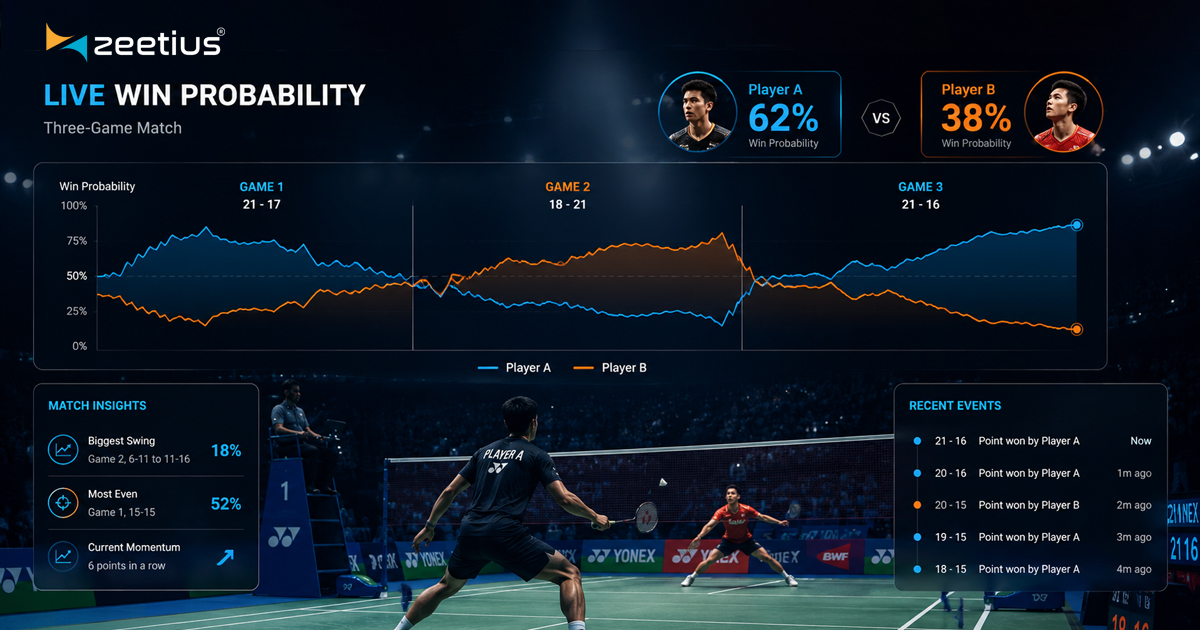
- ZetAI Predict — live win probability, next-point likelihood and player form, from sport-specific transformer models.
- ZetAI Coach — personalised training plans, fatigue and injury-risk flags, and drill recommendations from athlete biomechanics.
- ZetAI Score — officiating-grade automatic scoring across 30+ rule sets, plus automated draws and brackets.
- ZetAI Broadcast — AI camera switching, automatic highlight generation, commentary and on-screen graphics.
- ZetAI Fan — personalised content, sentiment analysis and interactive experiences.
Why six engines and not one model
The engines share a data substrate but not a model, because the tasks are genuinely different in kind. Tracking a shuttlecock at 240fps is a spatial problem measured in pixels and milliseconds. Forecasting a match outcome is a sequence problem measured over hours. Recommending a training block is a longitudinal problem measured over months. One model asked to do all three would be worse at each than a specialist, and impossible to reason about when it got something wrong.
What makes the training data unusual
Most sports AI is trained on professional broadcast footage: the top tier of a handful of sports, filmed by professional crews, in ideal conditions. It performs beautifully on more of the same and falls apart on a school gymnasium.
Our data is the opposite. It is district championships and state meets and academy leagues, across thirty sports, filmed on whatever cameras the venue had, scored by volunteers. It is messier, and it is enormously more representative of where sport is actually played.
It is also labelled, which is the part that is genuinely hard to replicate. Every rally in the archive has a confirmed, officiated outcome attached, because a human umpire signed off on it at the time. That is a supervised training set of a size and quality that cannot be bought, and it exists only as a by-product of having run the scoring for those tournaments.
What it changes today
ZetAI is not a separate product with its own login. It appears inside the products you already use.
- Live pages show win probability updating each point.
- Match analysis after a game breaks down rally length, scoring patterns and momentum shifts.
- Coaches in Zeetius Academy get load, fatigue and injury-risk signals against each athlete.
- Broadcasts on Zeetius TV get automatic highlights and camera selection.
- Draws and scoring get faster and need less intervention.
What we are not claiming
ZetAI does not replace officials. Auto-scoring assists an umpire and flags disagreements; it does not overrule anyone, and every match still has a human whose confirmation is authoritative.
Predictions are probabilities, not forecasts — a 90% win probability means the trailing player wins one time in ten, and we present it that way rather than as a prediction of the result.
And injury-risk signals are not medical advice. They flag workload patterns that historically preceded problems, for a coach or physio to act on with judgement. Any sports AI vendor telling you otherwise about any of these three is overselling.