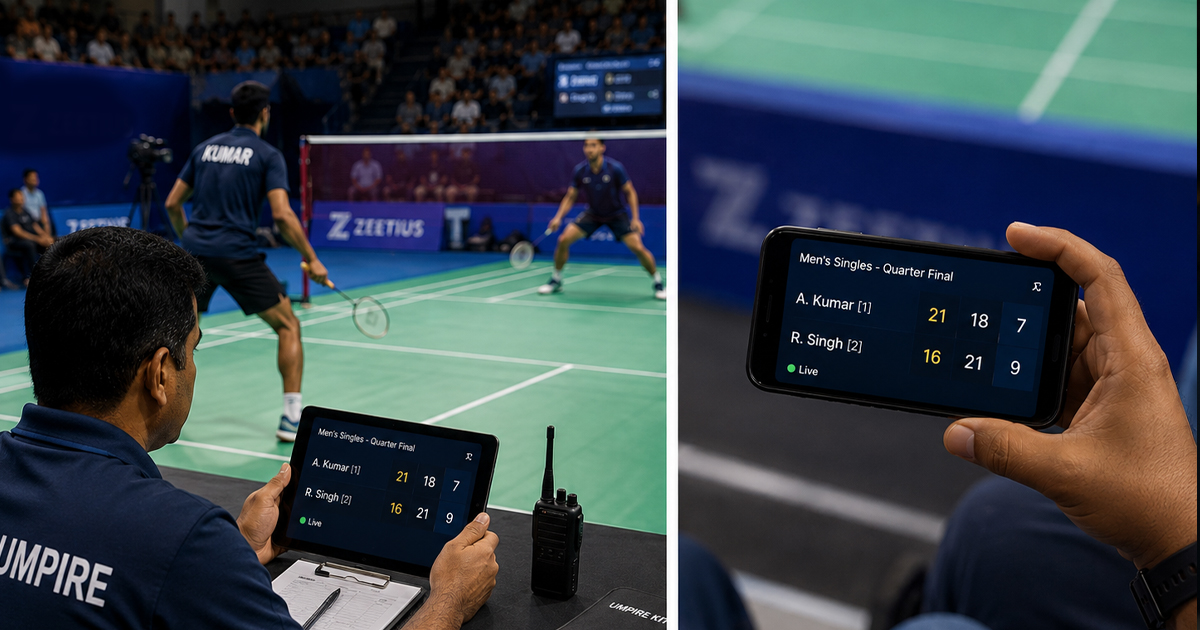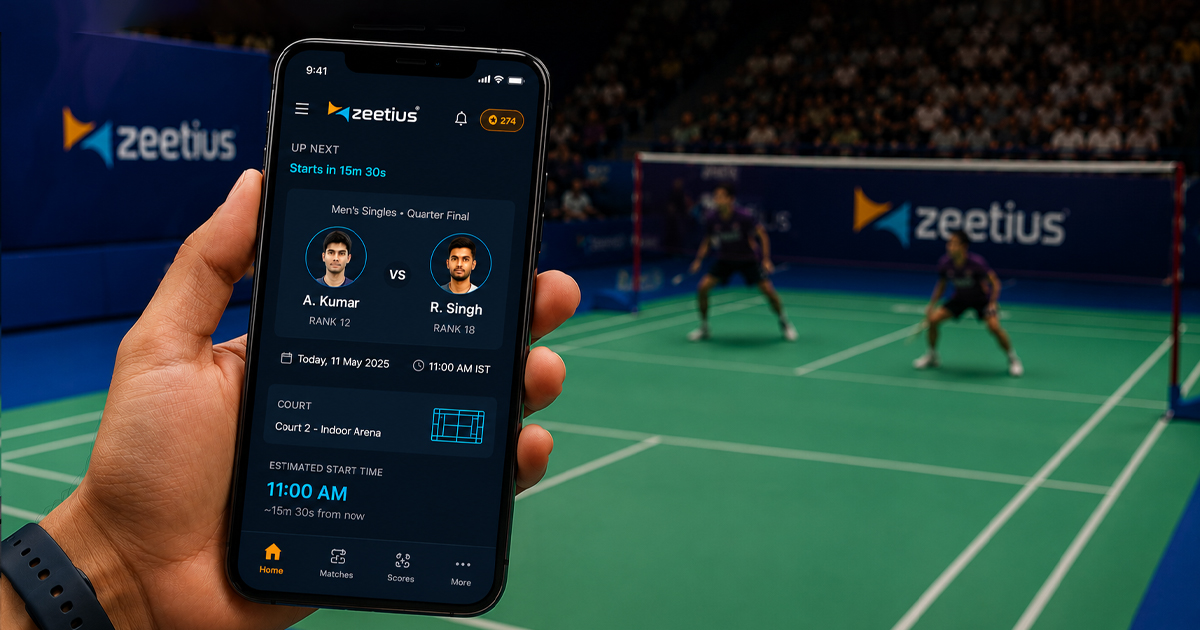







Product
Zeetius TV: How to Stream Eight Courts at Once Without a Production Crew
Multi-court streaming with live scorecards, automated graphics and sponsor inventory — built for associations that do not have a broadcast budget.
Broadcast used to be a binary. Either an event was big enough to attract a broadcaster and got a full outside-broadcast setup, or it was not and got nothing at all. Almost every tournament in the world falls on the wrong side of that line.
The interesting thing about the last few years is not that streaming got cheaper. It is that the two hardest and most expensive parts of a sports broadcast — knowing the score, and knowing which court is worth watching — became solved problems for anybody already running live scoring.
The graphics problem solves itself
In a conventional production, a person operates the scorecard graphic. They watch the match and update the overlay. It is a full-time role per feed, which is precisely why multi-court coverage was economically impossible: eight courts meant eight graphics operators.
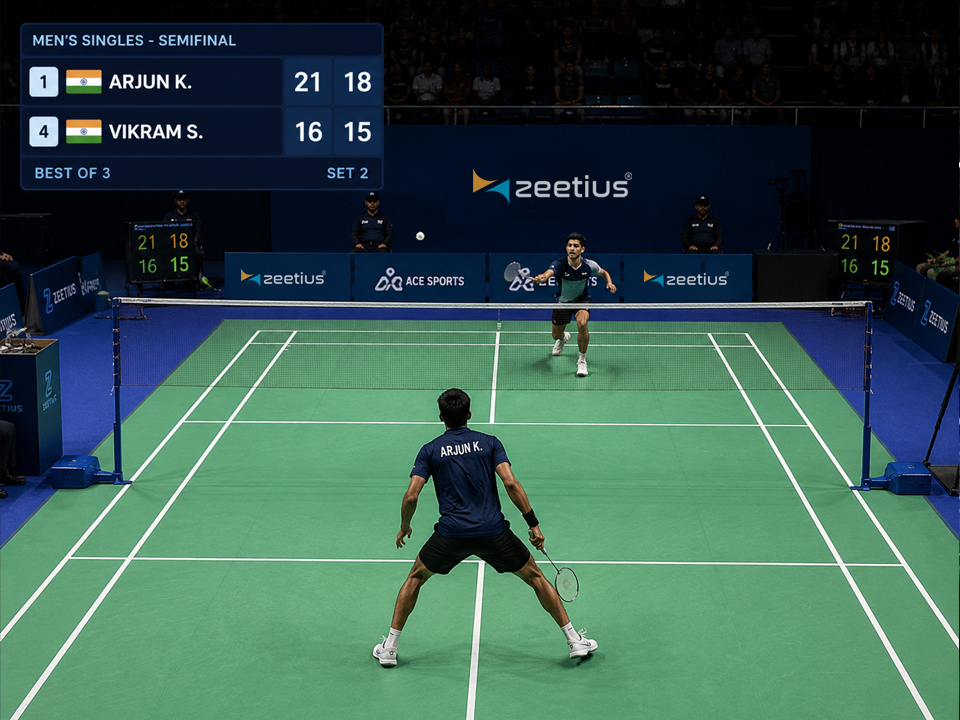
When the tournament is already being scored on Zeetius Live, the overlay reads the score directly from the event stream. Names, seedings, set scores, current game, serve indicator, match status — all of it is already structured data arriving in real time. The graphic is a subscriber to the same stream the public scoreboard subscribes to.
That removes the per-feed human cost, and with it the reason multi-court streaming did not exist at this level.
Data-driven overlays, not operated ones
Because the overlay is generated from tournament data rather than typed, it is also correct in ways a human operator cannot reliably be at hour seven of a tournament day: the seeding is right, the spelling of an unfamiliar name is right, and when an umpire corrects a point the graphic corrects with it.
Which court is worth watching
The second expensive judgement in a live production is direction — deciding, moment to moment, where the interesting thing is happening. With eight simultaneous feeds and no gallery, that decision has to be made by the viewer, and the viewer needs help making it.
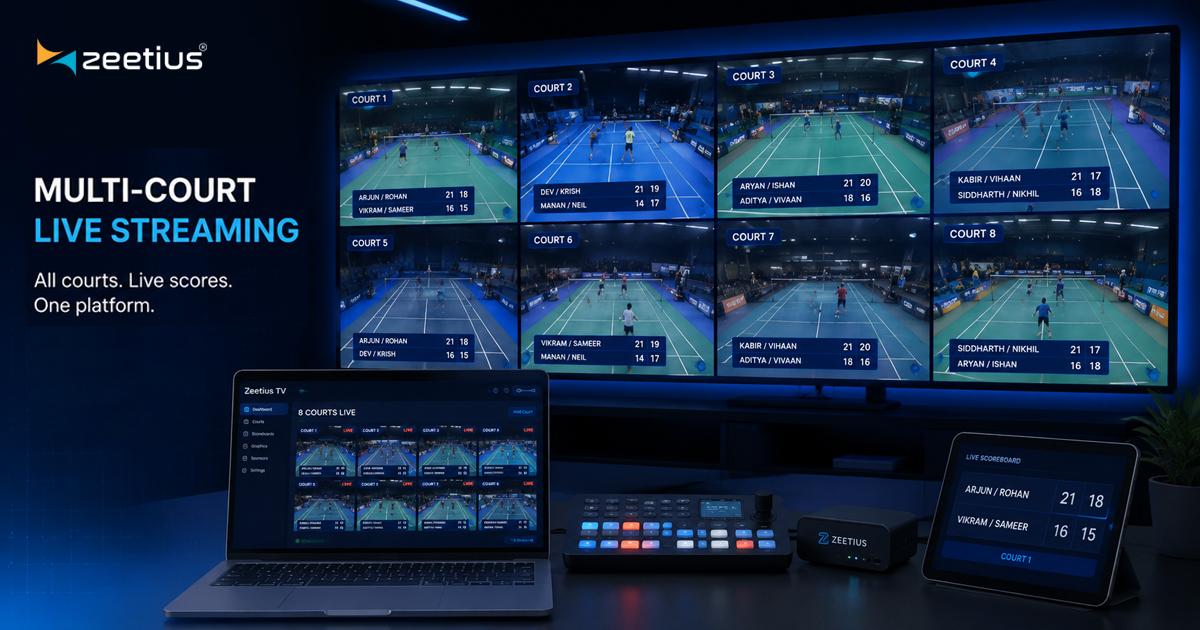
The multi-court view is a grid of every live feed with its current score attached. A viewer scanning it can see that court three is at 19-all in a deciding game and court six is 21-8, and choose accordingly. That is a better experience than a single directed feed for the audience that actually watches these events, which is overwhelmingly people with a specific interest — a club, a district, a family member — rather than neutral viewers wanting a curated show.
Where the revenue is
Streaming is usually pitched to associations as fan engagement. It gets funded as sponsorship inventory.
- Pre-roll and mid-match slots across all feeds, sold as one package or per court.
- Persistent branding in the scorecard overlay — the graphic that is on screen for every point of every match.
- Court sponsorship, which becomes sellable once each court is individually watchable and has its own viewership figure.
- Highlights and shorts that carry sponsor branding into social channels after the event, where most of the reach actually accumulates.
The step change is measurability. A sponsor who previously bought a banner at a venue and received an attendance estimate now receives a viewership figure per court, per session, with engagement data behind it. That is a fundamentally different sales conversation, and it is the reason the sponsorship number moves rather than just the audience number.
What an association actually needs
Cameras on the courts you want to cover, an uplink with enough headroom for the number of concurrent feeds, and the tournament running on Zeetius so the scoring data exists. No gallery, no graphics operators, no dedicated production staff.
The realistic constraint is almost always the uplink rather than the cameras. It is worth testing the venue's actual upload capacity a week beforehand, at the time of day the tournament will run, because a hall that tests fine on a Tuesday morning behaves very differently with four hundred people in it.