






AI
Injury Prevention AI: Spotting Load Problems Before They Become Injuries
Most overuse injuries are visible in training and competition load weeks ahead. The data usually exists — nobody is looking at it in one place.
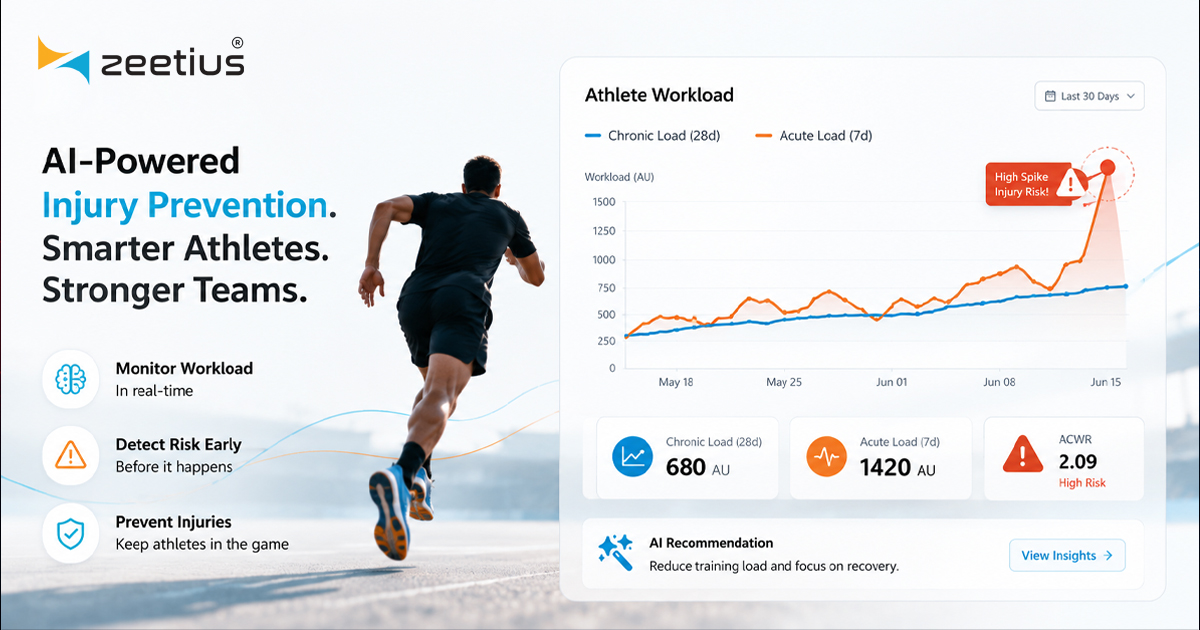
Acute injuries — the rolled ankle, the collision — are largely bad luck. Overuse injuries are not. They are the predictable end point of a load pattern that was visible for weeks, in data that almost always already exists and that nobody was looking at in one place.
The pattern that precedes most of them
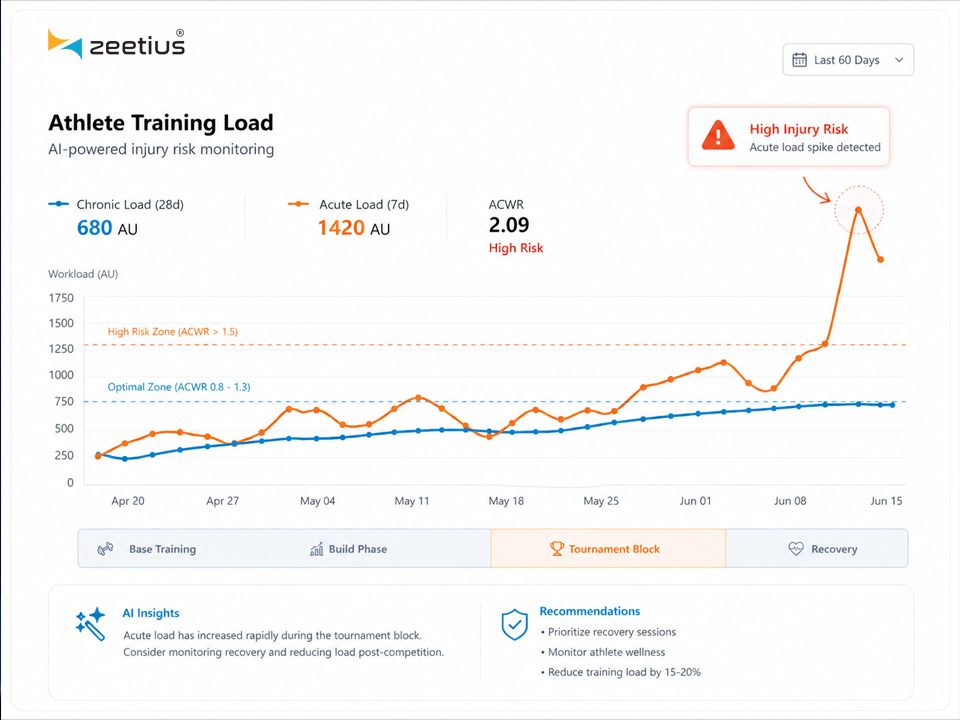
The best-established finding in sports medicine on this is the relationship between acute load (roughly the last week) and chronic load (roughly the last month). An athlete whose recent week substantially exceeds what their body has been conditioned to over the previous month is at materially elevated risk.
The classic sequence in junior sport is depressingly consistent. An athlete trains four sessions a week for two months. A tournament block arrives: three days, singles, doubles and mixed, eleven matches. Their acute load triples. They come back to normal training immediately because the next tournament is in a fortnight. Three weeks later, a knee or a shoulder.
Every element of that was recorded somewhere. The training sessions were in the academy register. The eleven matches were in the tournament system. The return to training was in the register again. Nothing joined them up, so nobody saw the spike as a spike.
The value is in the join, not the model
The honest thing to say about this feature is that the modelling is not the clever part. Acute-to-chronic ratios are well-documented sports science that any physio can compute. What has been missing is a system that holds an athlete's training attendance and their competition load in the same record — which Zeetius Academy and the tournament platform together now do, without anyone entering anything twice.
What ZetAI Coach adds on top
- Automatic load accumulation from attendance, session type and duration, plus every match played on the platform including its actual length and intensity rather than a nominal figure.
- Ratio monitoring against the athlete's own chronic baseline, not a population average — a fifteen-year-old training six days a week has a different safe ceiling from one training twice.
- Movement-quality degradation where ZetAI Vision is available: recovery speed to base position and movement asymmetry both tend to deteriorate before an athlete reports anything.
- Forward projection against the tournament calendar — flagging that an athlete is entered in three events across two weekends before the entries close, rather than after.
What it is not
It is not a diagnosis, and we are careful about the language in the product for that reason. The system says "this athlete's acute load is 2.4× their chronic baseline and their entry list adds eleven matches next week" — an observation about workload. It does not say the athlete will be injured, and it does not recommend medical action.
What a coach or physio does with that is a clinical and coaching judgement involving everything the system cannot see: how the athlete is actually moving, what they are reporting, their injury history, and what the season is for.
There is also a real risk in over-alerting. A flag that fires constantly gets ignored, and then the one that mattered gets ignored too. We would rather flag less and be taken seriously — the thresholds are deliberately conservative and configurable per academy.
Where to start
Attendance. It is unglamorous, it takes ten seconds a session on a phone, and it is the input that makes everything above possible. An academy that records attendance consistently for one term has a chronic baseline for every athlete, and from that point the competition load flows in automatically from tournaments already running on the platform.
The academies getting value from this were not doing anything sophisticated. They were just the ones who marked the register.